Photographing Pulpit Rock from the water
From a boat, Pulpit Rock is a ledge 604 m (1,982 ft) above your head, and the hard part is fitting the whole cliff into one frame. Most of the good shots come at a handful of pauses where the skipper slows down. Where you stand and how dry you keep the lens matter more than the camera you bring.
Get outside for the stops
The catamarans have big lounge windows, and on the long run out from Stavanger they make a comfortable place to sit. Glass adds reflections, though, and on a wet day raindrops streak the outside. For the main sights the open deck wins every time. All the tours pause at the same spots. Vagabond's Cave at Fantahålå comes first, then Pulpit Rock seen from below. After Hengjanefossen, the waterfall people call Whisky Falls, the boats turn for home.
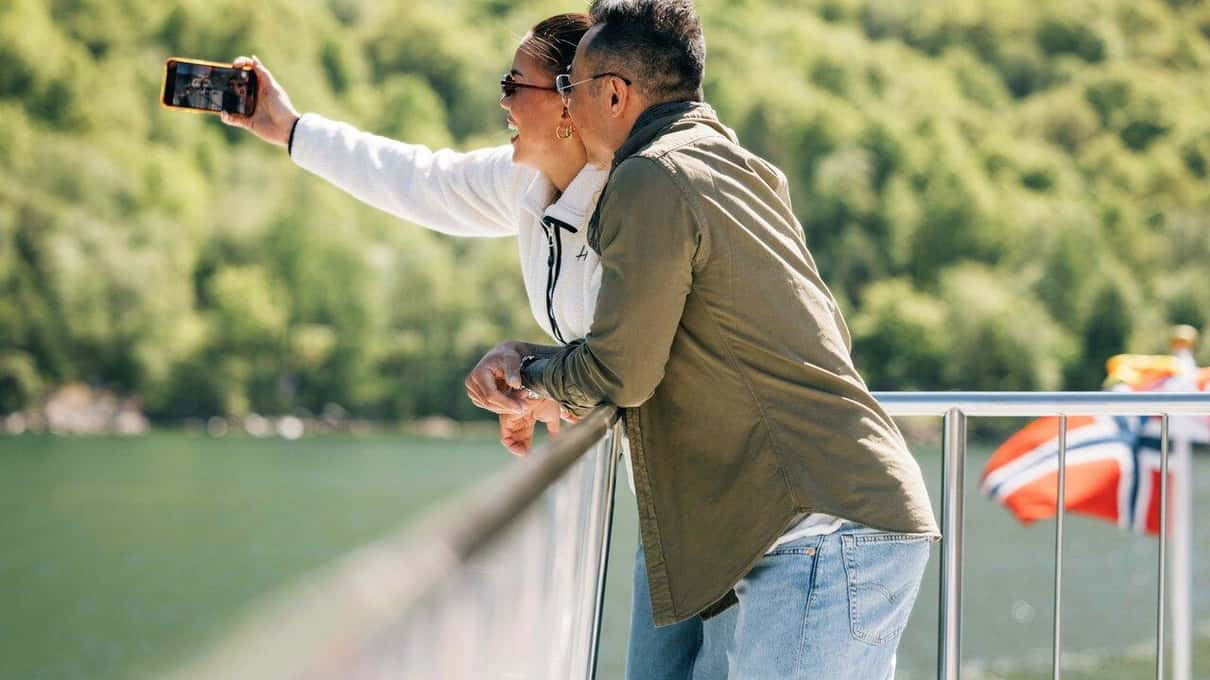
How long you get at each varies by boat. The Brim Explorer cruise at ~$83 lists about 15 minutes per sight, the longest of any tour here. Its three outdoor decks give everyone room to spread out. The Stavanger RIB at ~$145 gives about 10 minutes at each, and the FjordEvents RIB at ~$124 about 5. On the 2.5-hour Helgøy catamaran at ~$89 the boat gets close to the main sights, and one reviewer mentioned the crew taking photos of guests with the cliffs behind them, which beats a wobbly selfie.
Fitting a 604 m cliff into the frame
From the water, Pulpit Rock looks smaller than most people expect. The flat ledge crowns a wall that rises almost straight out of the fjord, and from below it reads as a notch on the skyline rather than the platform you know from photos taken on top. To show the scale you need the whole wall, water included.
- Use the ultra-wide lens. On most recent phones that is the 0.5x setting, which takes in the waterline and the ledge together;
- Try a vertical panorama. Start at the water and sweep slowly upward. A moving boat makes this fiddly, so take several;
- Put something in the foreground. The bow gives the eye a size reference, and a friend in a red jacket works even better;
- Zoom in for the ledge itself. On a clear day a 3x or 5x lens may pick out tiny figures standing near the edge.
Low cloud can hide the top completely. One Brim guest watched Pulpit Rock vanish into a whiteout and still rated the trip highly. Shoot the mist anyway, since a cliff disappearing into cloud often makes a moodier picture than a blue-sky postcard. Our rain and weather guide covers gray days, and our cruise or hike guide compares the view from below with the view from the top.
Light between steep walls
The Lysefjord is narrow, with cliffs reaching up to about 1,000 m (3,280 ft), so for much of the day one side of the water lies in shadow. That means high contrast, with a bright sky over a dark cliff. Tap the rock on your screen to set the exposure and let the phone's HDR do the rest. Around midday the sun reaches deeper into the fjord, which helps if you want the water to sparkle. Low winter sun leaves long shadows for most of the trip, as our guide to the seasons explains.
Overcast days are kinder than they sound. Soft light flatters waterfalls and green ledges, and cloud hanging on the ridges gives the walls depth.
Spray at Whisky Falls
Hengjanefossen drops about 75 m (246 ft), according to the listings, and some boats edge in close. The Rødne electric cruise at ~$93 goes near enough that you feel the spray, and the Fjord Xplore speedboat does the same. It is a fun moment and also the moment lenses get wet. A few drops on the glass turn a sharp shot into a smear.
- Carry a microfiber cloth in a dry pocket and wipe between bursts
- A clear waterproof pouch on a lanyard keeps a phone dry and attached to you
- Shoot as the boat approaches, then step back under cover for the closest part
- Film a few seconds of video, since the roar and the drifting spray come across better than in a still
Three outdoor decks and longer stops
Brim Explorer's hybrid ship, from ~$83 for 3.5 hours, lists about 15 minutes at each main sight. Saloons with floor-to-ceiling windows cover the cold stretches, and a live English-speaking guide tells you what you are looking at.
Shooting from a RIB or the speedboat
A RIB is a different camera environment. You wear goggles and gloves while the boat bounces at speed and spray comes over the sides, so photos happen at the stops rather than on the way. FjordEvents asks guests to keep phones and cameras secured for good reason. Anything dropped from a RIB in the fjord is gone.
- Use a wrist strap or lanyard, and keep the phone inside your suit between stops;
- Pull off one glove for the shot, then put it straight back on;
- Leave a big camera on the ship. Goggles get in the way of a viewfinder, and salt spray is hard on lenses;
- Swap phones with the person beside you. A row of matching yellow suits makes a fun group shot.
The Fjord Xplore speedboat at ~$166 is easier than an open RIB, with proper seats and a convertible sun-top for shelter. It still runs at 25–35 knots, so hold the phone with both hands. Our clothing guide covers staying warm enough to keep your hands steady.
On the way out and back
Two good shots come before the fjord. Leaving the Vågen, look back at Old Stavanger, whose white wooden houses climb the slope above Strandkaien, often with a cruise ship moored right beside them. Cruise passengers get a picture of their own ship that is impossible from the quay. Later the boats pass under the Lysefjord Bridge, a suspension bridge opened in 1997 near the mouth of the fjord. Shoot it at an angle on the approach so the span cuts across the frame.
Wildlife takes patience and a zoom. Goats graze on ledges near the shore, mostly in the warmer months, and Rødne visits a pair called Gunnar and Sigve. Seals and porpoises turn up now and then, and sea eagles sometimes circle the cliffs. Digital zoom turns a distant eagle into a smudge, so use the telephoto lens if your phone has one. Our route guide lists each stage in order, and on a port day our fjord and town plan leaves time to photograph Old Stavanger on foot as well.