What to wear on a Lysefjord cruise
Stavanger can feel mild on the quay and wintry at the rail once a catamaran gets up to speed. The big boats have heated lounges, but Pulpit Rock is best seen from the open deck. Dress for spells of wind and spray, and pack light enough to walk straight off your ship or out of your hotel.
The deck is colder than the forecast
Weather apps give you the temperature in town, not on a boat moving at a fair speed across open water. Leaving the Vågen, the catamarans head out among islands and fish farms toward the mouth of the fjord, and that stretch catches whatever wind is coming in off the sea. Add the breeze the boat makes by itself, and a pleasant 18 °C (64 °F) on the quay can feel like early spring at the bow. One Helgøy reviewer found the outer deck cold and windy on a sunny day and said a windproof coat was a must, along with something warm for the head and hands.
Inside the Lysefjord the granite walls climb to around 1,000 m (3,280 ft), and the air between them tends to be cooler and gusty. You will not stand out there for the whole trip. Every big boat has a heated lounge with large windows, and plenty of people sit inside on the way out. Good clothing is about staying outside for the twenty minutes that matter, when the skipper slows below Pulpit Rock and noses toward Hengjanefossen.
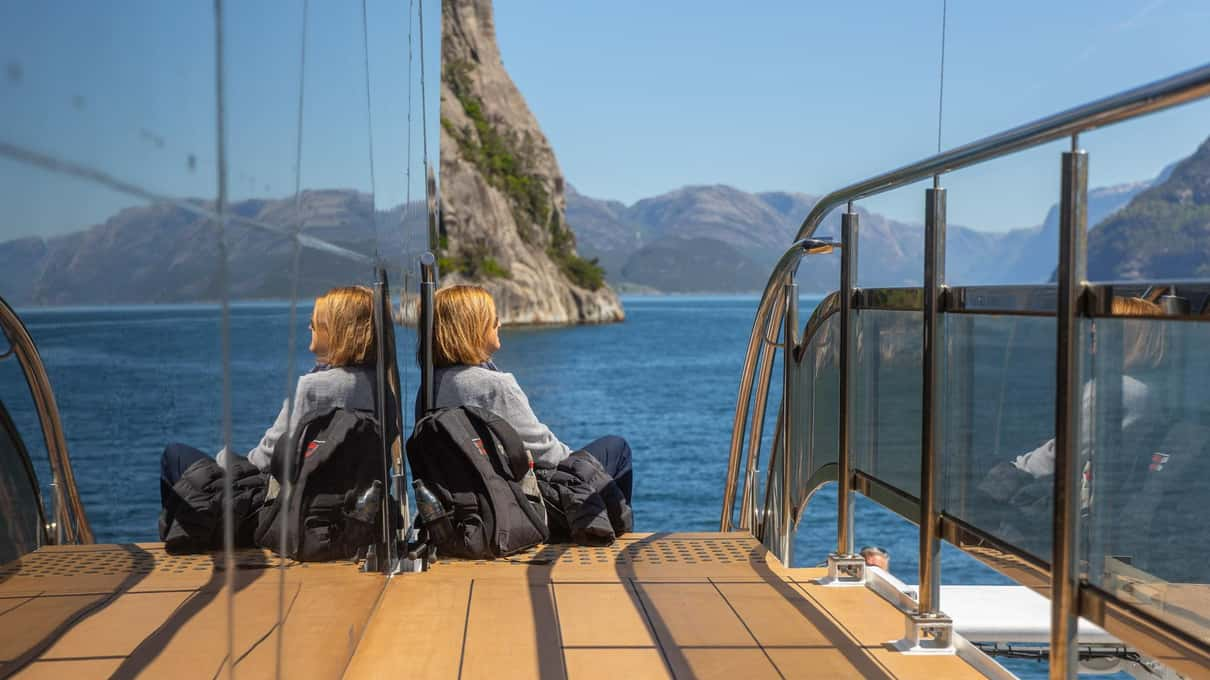
Layers that work in any month
Several thin layers beat one thick coat, because you will move between a warm lounge and a windy deck more than once. This set covers most of the year.
- A base layer of merino or synthetic fabric, which stays warm if drizzle gets to it. Cotton turns cold and clammy instead;
- A fleece or thin insulated jacket to peel off in the lounge;
- A hooded shell that blocks wind and rain, the one piece we would never leave behind;
- A beanie and light gloves in a pocket, in July as much as in October;
- Long pants, since bare legs go numb fast at the bow.
From late fall to early spring, swap the fleece for a down or synthetic puffer and add a scarf or neck gaiter. Stavanger's coastal winters are mild by Norwegian standards and often stay a little above 0 °C (32 °F), yet damp air on the water bites harder than the number suggests. Our guide to the seasons covers daylight and which boats keep sailing in winter.
Rain gear without the umbrella
Stavanger has a wet coastal climate, and the big boats go out in rain as well as sun. Rødne says so in its listing. Leave the umbrella in your cabin or hotel room, because a gust on a moving deck will flip it in seconds and nobody behind you can see past it. A hood does the same job and leaves both hands free for the rail and a phone.
Light rain pants help on gray days, mostly for the ride home. Sitting in a heated lounge in soaked jeans for an hour is a dull way to finish a fjord trip, and a thin pair folds small enough to live in a jacket pocket. Our rain and weather guide explains what low cloud does to the view of Pulpit Rock.
Shoes for a wet deck
Spray and drizzle leave the decks slick, and the catamarans have stairs between levels. Sneakers or trail shoes with a rubber sole are ideal, while smooth leather soles and heels are better left behind. Waterproof shoes earn their place in the colder months. RIB riders often say wet feet were the one thing the suit did not fix. Cruise passengers should walk ashore in the pair they plan to sail in, since the boats leave a few minutes from the berths and a spare pair is one more thing to hold all day.
Kitted out before you board
The FjordEvents RIB from ~$124 handles the clothing problem for you. Before you board you get a floating suit in your size, a life vest, goggles and gloves. The 2-hour trip stops for about 5 minutes at each sight, and cancellation is free up to 24 hours ahead.
What the RIBs and the speedboat give you
On the fast boats most of your outer gear is provided. On the FjordEvents RIB at ~$124 and the Stavanger RIB at ~$145 you pull a floating suit over your own clothes and a life jacket over that. The crew hand out goggles and gloves as well. Stavanger RIB stocks suits from 2XS to 4XL. The Fjord Xplore speedboat at ~$166 also hands out a floating suit, and although it has a hood, the company still suggests bringing a cap or beanie. That tells you something about the wind at 25–35 knots.
Underneath, dress as you would for a cold walk. A fleece over a base layer is enough in summer, and thermal layers help in spring and fall. A bulky coat makes the suit tight, so leave it with your bag. FjordEvents asks you to secure anything loose, from hats to phones, because it can blow overboard at speed. A snug beanie under the hood stays put far better than a cap with a brim. Our RIB or cruise comparison explains who the fast boats suit.
Fjord Xplore makes the logistics simpler. Bags can stay in the boat cabin or at the boathouse, and there is a WC at the boathouse, handy before you zip into a suit for close to three hours.
A small bag off the ship
Cruise passengers tend to bring too much ashore. The berths at Strandkaien and Skagenkaien sit a short walk from where every tour starts, so a small daypack or a crossbody bag covers a fjord trip and an afternoon in town.
- Your cruise card, plus the photo ID your ship asks you to carry ashore
- A payment card for the snack bar, since Norway runs almost entirely on cards (Rødne sells waffles and cinnamon buns, and Brim has a cafe)
- A warm layer, with your cold-weather extras stuffed in its pockets
- A charged phone in a zipped pocket
- A water bottle, which Brim lets you refill from the tap on board
Large backpacks are better left in your cabin. A daypack fits at your seat on a catamaran, but on a RIB anything outside the suit gets wet, so carry the minimum. On a day when your ship is parked out at Mekjarvik, everything you take comes with you on the shuttle, so pack once and expect to carry it until evening. Our guide for cruise passengers covers the walk from each berth and the buffer to keep before all-aboard.
Dressing children and older travelers
Kids lose heat faster than adults in wind, and they tend to stay at the rail longer, so pack one more layer per child than you think they need. Mittens beat gloves for small hands. Older travelers who feel the cold can stay in the lounge and step out only for Pulpit Rock itself. Our families and accessibility guide lists the age limits for each boat, and the photography guide explains why touchscreen fingertips on your gloves help at the rail.